Brett Hurd · Systems Analyst, Koniag Government Services · Active Secret Clearance

I build agentic systems and I know how they fail

Fourteen years where being wrong was expensive taught me where to look. Nine years as an Airborne Infantry NCO, then systems and vulnerability work for the State Department.

01 / Approach

Posture and method

What happens on the hundredth run

A demo shows one thing: the system produced the right output once, on a good day, on an input somebody picked. Tooling made that easy, and easy answers are not worth much.

I care about the hundredth run. The input nobody planned for. The dependency that drifted while nobody was watching. When these systems fail they rarely crash — they hand you something confident, well-formatted, and wrong.

I spent fourteen years in places where that distinction was the job. Nobody called a control real until somebody tried to break it, and whoever signed the risk needed it in plain language rather than a demo. I am applying the same habit to agentic systems.

  1. 01

    Adversarial first

    A control nobody has tested is an assumption. The useful work is finding the input, the sequence, or the state where a system returns a wrong answer, and finding it on purpose before it costs anything. I built that habit reviewing access and vulnerability work, and it transfers straight to an agent's tool-calling loop.

  2. 02

    Failure is the artifact

    A passing run tells me little I did not already hope for. What I keep is the catalog: which conditions degrade the system, how far, and whether it stops and says so or keeps going. A system that fails loudly is often safer than one that scores better on a happy path.

  3. 03

    The decision-maker is the end user

    An evaluation a non-specialist cannot act on is not finished. I deliver a stated risk, a recommendation, and an honest account of what I did not test — in the language of the person who signs for it. I have written that document for executives about vulnerability protocols.

02 / Record

2012 — present

Scope, not stack

Fourteen years in systems where being wrong carried a cost. I have listed what I owned and at what scale, because that is the part that transfers.

2024 — Present

Systems AnalystKoniag Government Services

  • Role-based access control and credential verification for 350+ U.S. State Department and Embassy personnel. Zero unauthorized system access across a two-year tenure.
  • Audited 200+ State Department domains and remediated 320+ privilege-escalation risks in three months.
  • Evaluated 9 enterprise vulnerability-management solutions and briefed executives with the feature and cost-benefit matrix behind the way-forward decision.
  • Executive-level risk-management consultation. Led the overhaul of vulnerability protocols for WordPress-based platforms.

Why this line mattersThe third item is an evaluation run end to end: nine candidate systems, one comparison framework built before I looked at any vendor, one recommendation briefed to executives. Building the criteria before seeing the options is the part people skip.

2023 — 2024

Intern, Cyber Defense / SOC AnalystCarolina Cyber Center

  • Completed 100+ SOC and Red Team modules on RangeForce.
  • Ranked 24 of 336 on the center leaderboard.
2021 — 2023

Consultant, Innovation & Design ThinkingNAVALX / Red Team This

  • Led 12 experts drawn from industry, academia and government to develop secure information-system and network concepts for joint and partner Special Operations Forces operating in austere environments.
  • Facilitated 10+ agile workshops. Military Scrum Master; Human-Centered Design.

Why this line mattersThe hard part was human. Twelve specialists with incompatible vocabularies had to agree on what a requirement meant, and that definition had to hold while the concept got pressure-tested. Translating between people who build systems and people who use them in bad conditions is a distinct skill, and it is the one most often missing.

2012 — 2021

Airborne Infantry NCO / Arctic Warfare AdvisorU.S. Army

  • Codified standard operating procedures for 12 arctic training exercises.
  • Trained 100+ soldiers on intelligence collection and security operations.
  • Oversaw talent management for a 20-person team.
  • 18 awards and medals across nine years of service.

Why this line mattersWriting an SOP is writing an evaluation in advance: before anything goes wrong, I had to specify what right looks like, what the failure conditions are, and what happens at each one. Doing that twelve times for arctic operations, where the environment removes your margin for error, is where the habit came from.

One method runs through all four: enumerate the failure modes, test them on purpose, then state the residual risk plainly to whoever has to accept it.

03 / Work

Independent projects

What I built, and what I run

Independent work. Each entry states what it is, the decision that shaped it, and what that decision bought. I have split what I built from what I operate, because the difference matters and you would ask anyway.

Built

Twenty-seven skills that define how an agent works before it acts: state the purpose of a project and what would count as done, rank competing work before starting any of it, pressure-test a plan by argument, and file what a session learned so the next one starts further along. Written one at a time — each one after a session went badly enough to want a rule.

The decision, and what it cost

Most agent tooling wraps an API call and leaves the thinking to a prompt. The gap I kept hitting was earlier than that: an agent that starts before anyone has said what winning looks like produces something competent and useless. So I made the process explicit and reusable. The purpose gets stated first, the work gets ranked before it starts, and what the session learned gets written down. That puts the judgment somewhere you can read it and argue with it, instead of buried in a prompt.
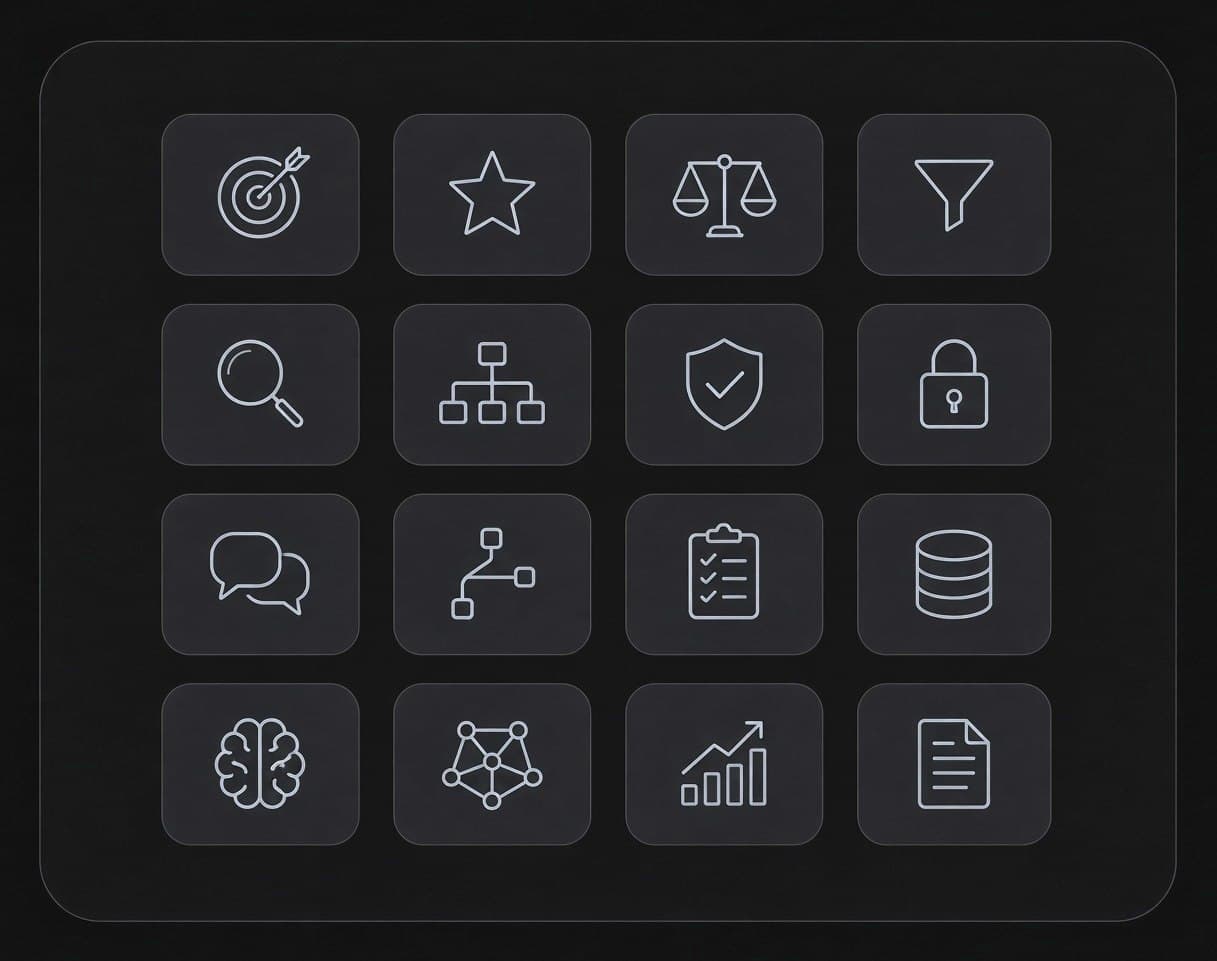
A grid of outlined icons — target, star, scales, funnel, magnifier, hierarchy, shield, lock, dialogue, branching path, checklist, datastore, brain, node graph, rising chart, document — representing the kinds of work the skills cover.

A cross-tool standard for configuring AI agents: one canonical instruction-file convention with per-tool bridging, applied across projects, alongside a set of reusable agent skills.

The decision, and what it cost

Every tool invented its own configuration file, and keeping five near-identical copies in sync is how behavior drifts between environments without anyone noticing until output diverges. One canonical file with generated bridges means the instructions an agent actually runs under are the instructions I reviewed. Generating the bridges keeps every copy in sync on its own, so drift stops being something anyone has to watch for.

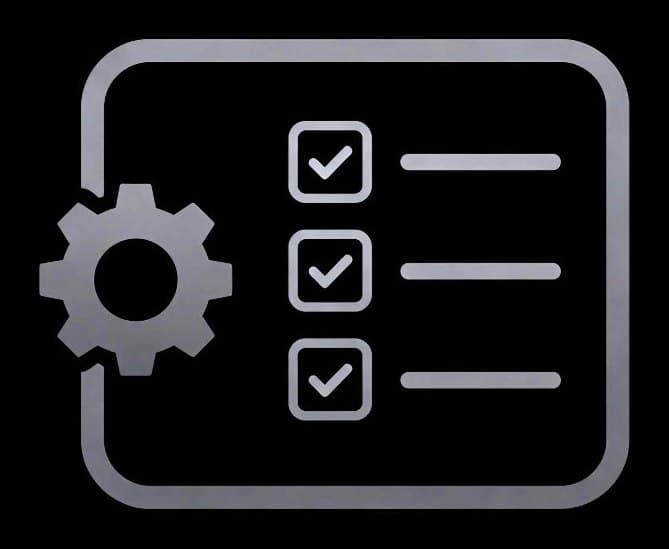
A gear meshed into the edge of a panel listing three checked items — one canonical configuration enforced across tools.

I trained LoRA adapters against FLUX.2, tuning training parameters to control model output.

The decision, and what it cost

The images were never the point. I chose image models because the feedback loop is visual and immediate, which makes them the cheapest way to build intuition for where output actually moves when one training variable changes — and, more usefully, where it does not move at all. That intuition is what stops me attributing a behavior change to the wrong cause later, on a system where the output is text and the error is not obvious.

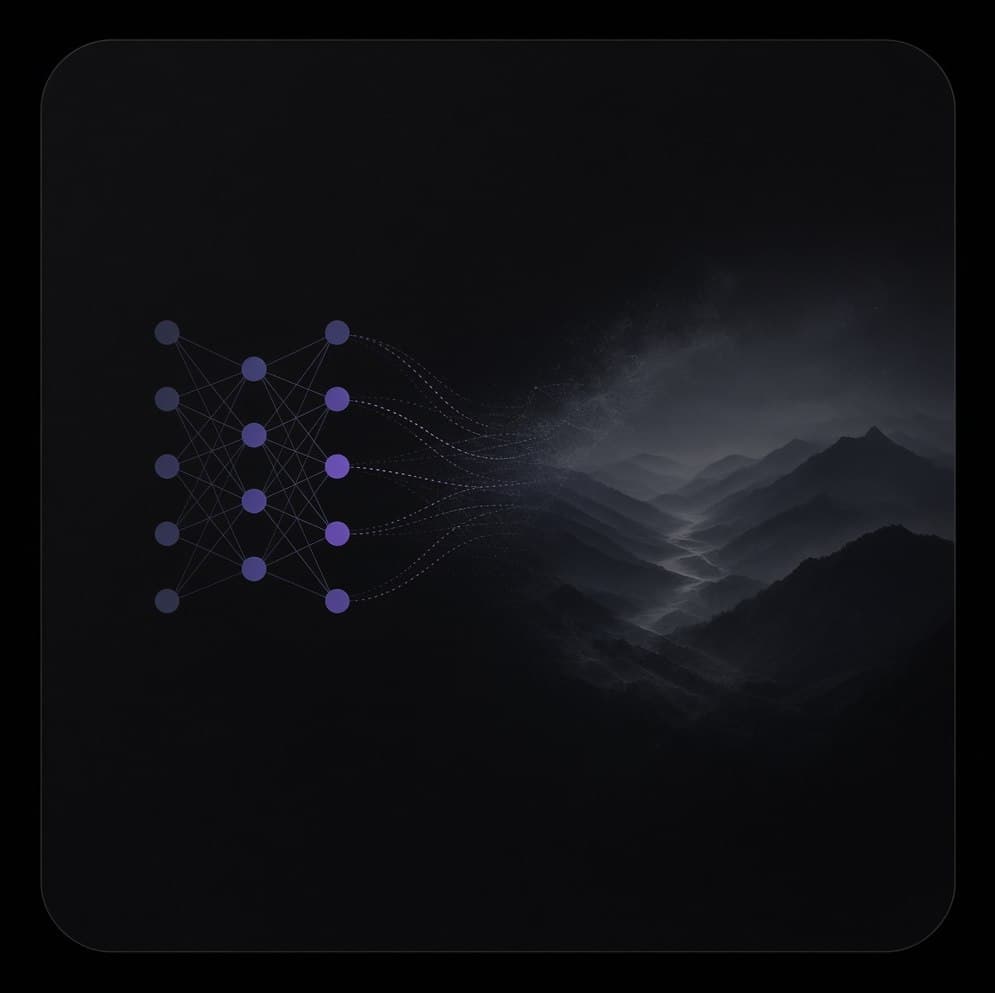
A small neural network of violet nodes on the left, its output paths dissolving into a rendered mountain landscape on the right.

Operate and extend

Specialized agents — research, analysis, build, test — running in parallel under an orchestrator, with primary-source verification and a human-in-the-loop review gate. I run it daily and have modified it to fit how I work.

The decision, and what it cost

Running one of these seriously is different from reading about one. Parallelism buys throughput and spends determinism: four agents that can each be wrong independently produce a composite answer nobody is accountable for. Primary-source verification and the human gate both make the system slower on purpose. Watching where that actually breaks, on my own work, is the part I could not have got from a write-up.

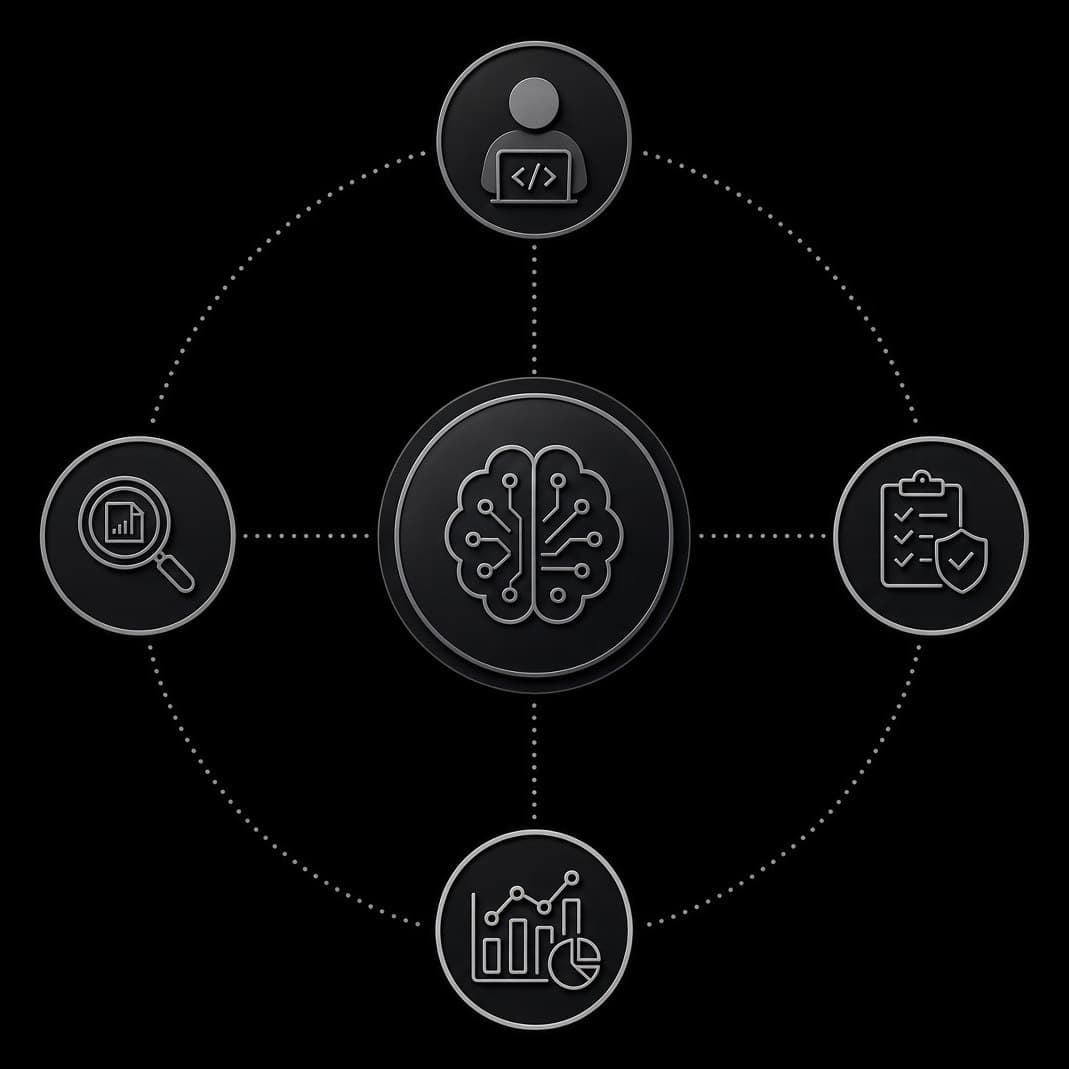
Orchestrator topology: a central orchestrator node ringed by four specialized agents — research, analysis, build and test — each connected to the center and to the ring.

An immutable source layer with provenance and drift checks, plus an agent-maintained wiki navigated by links rather than vector retrieval, with an explicit schema, index and audit log. I did not invent the layout. I built my implementation of it and have been extending it since.

The decision, and what it cost

Vector retrieval is fast to stand up and hard to interrogate — when it returns the wrong passage you are debugging an embedding space. Links are legible: the path an agent walked is a path a person can re-walk and disagree with. That choice costs real curation effort, which is why the immutable source layer and the drift checks exist. A knowledge base that quietly rots is trusted for exactly as long as it takes to cause a problem.

A brain built from interconnected nodes and edges, rising out of an open book — a knowledge base structured to be traversed by a model rather than read by a person.

Common thread: each of these came out of a claim that did not survive a second question. Building or extending the system myself is how I answer that second question honestly.

04 / Credentials

Certifications, clearance, education

Verifiable

Certifications

  • AWS Certified AI Practitioner2026
  • RangeForce Junior Penetration Tester Elite2024
  • Certiport IT Specialist – Python2022
  • IBM Enterprise Design Thinking Practitioner2021

Verify badges on Credly

Clearance & education

  • Active Secret clearance14 years continuous eligibility
  • A.A.S., Information Technology: Cyber SecurityWake Technical Community College · 2024
  • Cisco Networking AcademyCCNA: Switching, Routing & Wireless Essentials; Introduction to Networks · 2022

Capabilities

AI / ML
Agentic AI systems; multi-agent orchestration and agent configuration; prompt engineering; LoRA fine-tuning; tokenization and context optimization; Model Context Protocol (MCP); ComfyUI
Security
Vulnerability and risk management; RBAC and credential verification; enterprise user auditing. Trained in SOC and threat analysis, penetration testing and networking — 100+ RangeForce modules, ranked 24 of 336
Languages & tools
Python; HTML/CSS; Splunk; Burp Suite; Metasploit; Git; Linux; Windows; Cisco IOS
Leadership
Executive briefing and technical writing; cross-functional facilitation; roadmap planning; team leadership and training

05 / Contact

Direct message

Portrait placeholderBH

Brett HurdAgentic systems · high-consequence environments

One channel

LinkedIn is the reliable route and the one I read. If you are working on reliability or failure analysis for agentic systems in an environment where being wrong is expensive, that is the conversation I am most useful in.